2017

We move forward from two successful exhibitions in 2016 in Prague and in the USA to the challenge of an exhibition in the Netherlands in the Autumn. We continue to work on A2 sized pieces in portrait format and will be producing four pieces over the year with the theme of 'Freedom'. An essential part of our art is working in series to a common format which does give us all a framework for our creative endeavours.

Tuesday, 25 November 2014


'ABOBOGOKE'


I have always wanted to experiment with 'Bogolan' or mud cloth. After sewing 3 pieces of hand woven cotton together, I dipped the panel in Turmeric and water then dried it. I mixed henna powder and balsamic vinegar and used the resulting 'mud' to make my design which is based on Aboriginal symbols. The result is not as dark as I would have liked but I did have fun!!


Monday, 10 November 2014

Chaco Canyon, New Mexico: Marking the Middle of Time


Chaco Canyon is located in northwestern New Mexico, between Albuquerque and Farmington, in a remote canyon cut by the Chaco Wash. Containing the most sweeping collection of ancient ruins north of Mexico, the canyon preserves one of the United States' most important pre-Columbian cultural and historical areas.

Between AD 900 and 1150, Chaco Canyon was a major center of culture for the Ancient Pueblo Peoples.  Chacoans quarried sandstone blocks and hauled timber from great distances, assembling fifteen major complexes that remained the largest buildings in North America until the 19th century.  Many Chacoan buildings were aligned to capture the solar and lunar cycles, requiring generations of astronomical observations and centuries of skillfully coordinated construction.  Climate change is thought to have led to the emigration of Chacoans and the eventual abandonment of the canyon, beginning with a fifty-year drought commencing in 1130.  But, there is also a legend that the Chacoans who built and maintained the buildings at Chaco Canyon may have found a way to control certain natural forces, and when they fully realized the consequences of such control, they abandoned Chaco Canyon and the knowledge they had acquired, leaving the canyon and its buildings to the whims of those natural forces they had so long sought to command.  Remnants of that long abandoned power are palpable in the canyon to this day.  

I made this quilt using commercial fabrics and hand-felted pieces with beading and embellishments.  The "stones" in the old wall were cut and laid one by one--just as the ancient Chacoans must have laid the stones in their walls.  The five felted pieces are intended to represent the sun or the moon on its journey through the sky each day and night. 

Frances

Monday, 27 October 2014

Mother earth speaks to us......

'Mother earth speaks to us through plants  and flowers'

Buddist quote

This piece continues my series using discharge pastes on dyed backgrounds. The base cotton was a low immersion dyed piece in deep greens - I was keen to see the resultant colour after printing on leaf images with different pastes, after two layers I lightly overdyed the piece in a leaf green to restore the background depth and finally discharge a third time with some decollourant.  My intention was to try to create depth in the piece by having some soft unstitched images floating in the background.

It never ceases to surprise me the range of various pigments that get pulled out of the dyed fabric. I used anti-clor as a final soak to ensure all the agents had been removed.

The piece was sandwiched together as usual and I used machine embroidery/quilting to emphasize the printed shapes with rayon thread as I needed the stitching to show.


Tuesday, 21 October 2014


Primal Lizard


I found a wonderful image of a lizard rock painting found in Kakadu National Park in Northern Australia. The area is inhabited by the Bininj and Mungguy people. Some of the paintings found here are 20,000 years old!
 
I used 6 layers of fabric, ice dyed, hand dyed, some damask from West Africa, batik from West Africa and a piece of metallic fabric I found in a second hand market in Nairobi. Using the Molo reverse applique technique was quite difficult as all the fabrics had a tendency to fray. I added some machine embroidery and quilting using rayon threads and then embellished the piece using ostrich shell and brass beads from Turkana. 
 

Monday, 6 October 2014

Earth Quotes - When clouds appears like rocks........

"When clouds appear like rocks and towers, 
the earth refreshes with frequent showers."

Old Amish saying


The inspiration behind this piece is a chunk of Blue John rock from the Blue John mine in Derbyshire. An appropriate quote as the 'blue' of the rock vein is caused by the  rain seeping over the specific minerals underground over millenium. 

I used black cotton which I discharged initially with Jacquard discharge paste to get the light 'quartz' bands running down the  piece. I used  sponges to try to achieve different depths of texture in the rocks - I then used decollourant colour sample pots to add a range of rock like colours to the piece working from behind. (I always find the effects are much better when you are using colour replacement discharge paints if you work on the reverse.) Finally I added flecks of turquoise blue  for the Blue John crystals.


Blue John Rocks

I used a heavy rayon thread to emphasise the shots of turquoise that run through the veins with a whip stitch again working on the reverse to give a looser thread on top. Similarly with cream and variagated taupe threads to add texture to the 'quartz' veins. I added the odd bit of turquoise bling - (plastic small gemstones) to create the sparkle.

The background black rock was textured with free machine quilting.

Detail of rocks


Saturday, 13 September 2014

Cherries – A taste of summer


Cherries – A taste of summer – August 2014

Big, fat, juicy cherries come into season here in July. They are grown locally and in the nearby Rhone Valley and appear in local supermarkets, village markets and in wayside stalls which one can find all over this part of France in the summer. They are not around for long, so everyone makes the most of the few weeks they are available at quite reasonable prices.

The background fabric is cotton sateen from Stoll Weber. Cherry juice is depicted in the heavily quilted area with beads of juice dripping from the edge. I like text on my pieces as you know and the word Cerises, French of course for cherries, is quilted and filled with hand embroidered cross stitch using one of my hand dyed threads. The cherries are painted with fabric paint and shadows put in with more embroidery.

Saturday, 6 September 2014

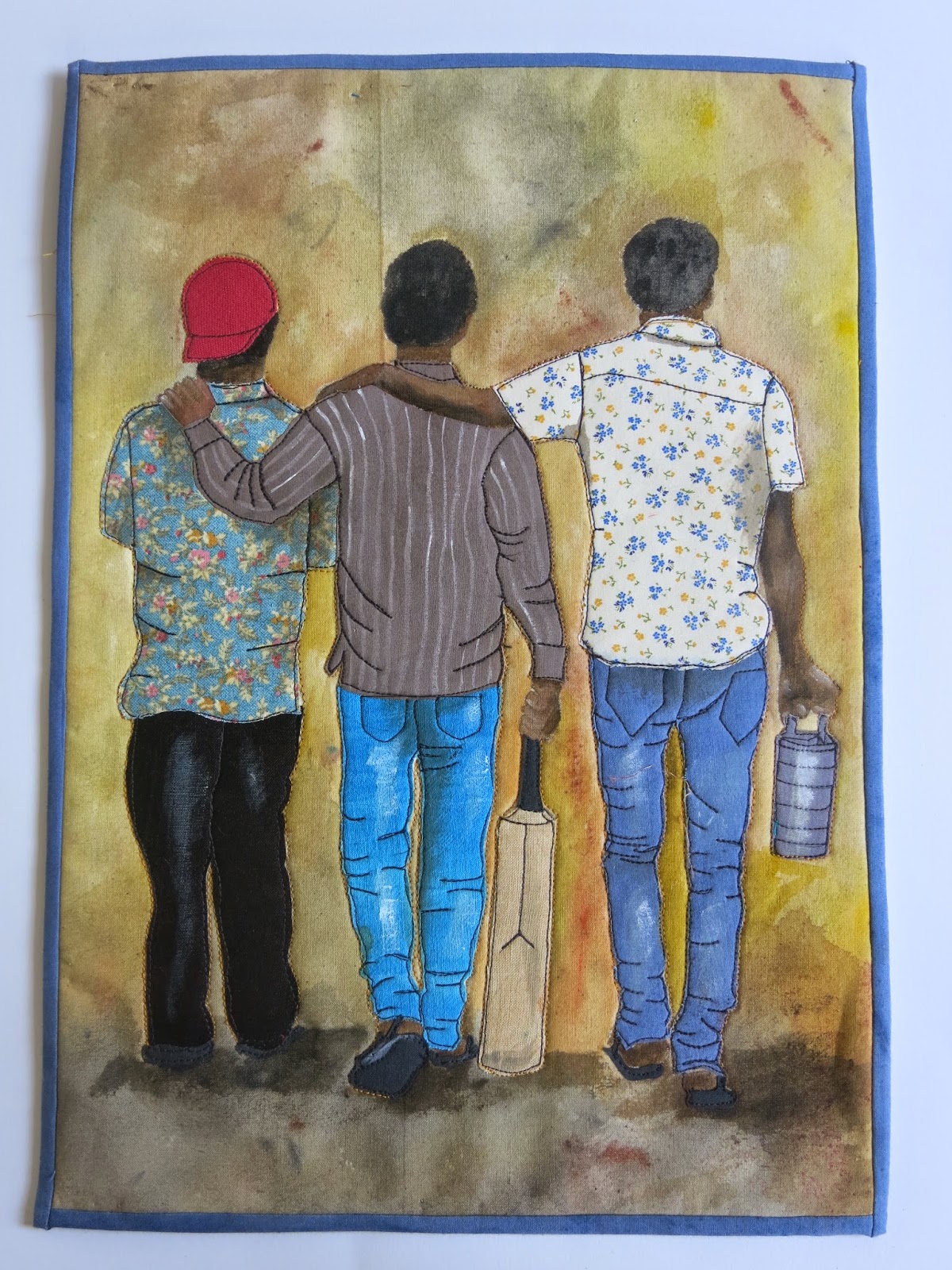
3 Indian boys

I love making my Indian Ladies quilts but am enjoying the challenge of making quilts featuring the men and pushing me to practice painting faces, although with this quilt it is a back view.
I photographed 3 boys walking down the street in Mumbai. It seemed such a typical sight. They have a cricket bat and a tiffin tin.
The background is painted with added applique in the same style that I have made the other 5 quilts. I have one more to make in the same style.


Gillian

Wednesday, 3 September 2014

Red Rock Crossing - Sedona, Arizona


I've changed my thinking about the power of the earth that is so abundant in Sedona, Arizona.  I used to think that the earth power came from the majestic red rocks around which Sedona is built.  My impressions have changed, though, during my last few visits to Sedona.  My favorite spot to visit in Sedona is Red Rock Crossing, a "vortex" point just outside of town where Oak Creek babbles and dances across some of those majestic red rocks.  Oak Creek originates more than 8,000 feet above Sedona as runoff from the volcanic San Francisco Peaks.  On its journey downhill, Oak Creek has carved the cavernous Oak Creek Canyon and has sculpted those majestic red rock formations that define Sedona.  I believe the real earth power in Sedona comes from the water.  That is what this quilt is about--the water at Red Rock Crossing.  Cathedral Rock is just a reflection in the water of Oak Creek--the towering red rocks shaped as a result of the power of the water of Oak Creek.

This quilt is my first serious attempt at thread sketching.  I have intentionally left the rocks virtually unquilted.  They emerge from the water just as they do from the waters of Oak Creek.  I printed a photograph on silk and added acrylic paint and organza to the rocks.  I thread sketched the water and reflections to make them the focal point of the quilt.


Sunday, 24 August 2014

The Liar's Cloth.  


This months subject is Silk.  There is a small amount of native silk in Africa.  Magagascar is well known for it's silk, both local and introduced.  A lesser known silk found in West African is woven into beige cloths known as Sanyan (Nigeria).  The cloth is rough and heavy and not at all like Chinese silk.  The background of this piece is a Sanyan cloth - it may be silk - but probably is not, but it's the closest I can get! The purple distressed piece is more than likely silk.  It is a wonderful scrap that I found while rooting through the many bags of scraps that my friend Akwazi hoards.  Akwazi is a Kente cloth dealer, he spends many hours repairing old kente cloths - so his bags of scraps are a) useful to him and b) an absolute delight to root through!! This piece has certainly lived a life.  The silk for this cloth would have been imported from Europe, either across the Sahara desert or by ship to the Gold Coast. At one time imported silk cloth was bought by the weavers, unravelled and then used in their own work. The bobbin of yarn is to represent this idea.  The pattern in the warp - the three crooked gold lines is called 'Liars cloth'.  Once worn by the king or chief to put off Liars in his court.  


Sunday, 3 August 2014

Another Man

Another one finished
I photographed this man whilst I was in India in February
Painted, with added applique and stitch
For some reason I have lost my cropping of the photo!